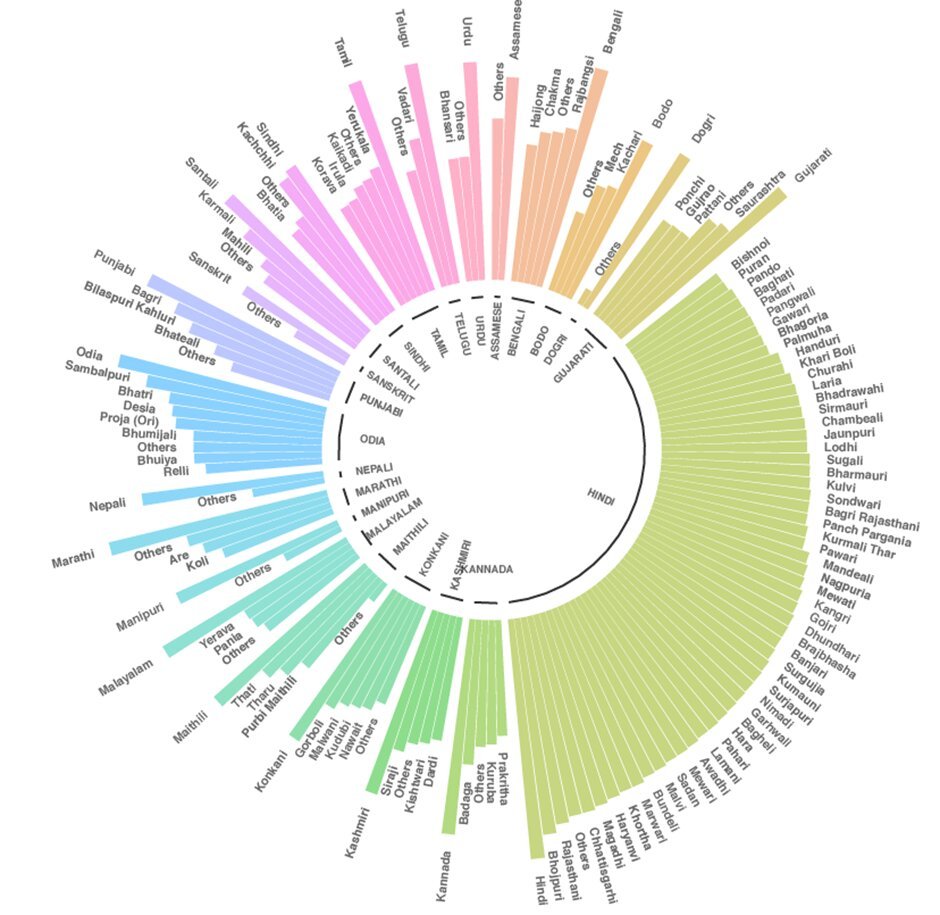
The Genetic Mapping of Speech
The incredible diversity of Indian languages is not random; it is highly structured into distinct "language families" shaped by millennia of migrations, ancient trade routes, and dynastic conquests. South Asia's languages belong primarily to four major families:
- Indo-European (primarily Indo-Aryan)
- Dravidian
- Austro-Asiatic
- Sino-Tibetan
The Demographic Breakdown
| Family | Share of Population | Primary Region |
|---|---|---|
| Indo-Aryan | ~73% | North, West, East India |
| Dravidian | ~24% | South India |
| Austro-Asiatic | ~6 million speakers | Central & Eastern pockets |
| Sino-Tibetan | <1% | Himalayas & Northeast |
India as a "Linguistic Area"
What makes India unique is that these distinct genetic families have heavily influenced one another. Scholar Murray B. Emeneau famously coined the concept of "India as a linguistic area" (Sprachbund) in 1958. Millennia of coexistence have led to shared structural features -- like retroflex consonants and similar sentence structures (Subject-Object-Verb) -- across these different language families, proving that shared cultural space often bridges genetic linguistic boundaries.
A Tamil speaker and a Hindi speaker share more linguistic features than either would with a European speaker of their own family -- geography binds language as much as ancestry.

Comments
Be the first to share your thoughts!